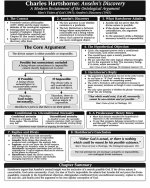
Charles Hartshorne was a 20th century philosopher who had studied under Alfred North Whitehead and Heidegger in the inter war years and later taught at the University of Chicago. He believed that he had rescued Anselm’s Ontological argument from Kant’s criticism and refined it ... Your thoughts?
In his 2010 article, "
Militant Modern Atheism", Philip Kitcher notes that with regards to “the ‘proofs’ offered in premodern theology” (such as that put forth by Anselm), "Whether anyone has ever regarded them as a potential route from atheism or agnosticism to theism is doubtful, and it seems plain that those who constructed the more-or-less intricate arguments did so in attempts to elaborate ideas about a deity to whose existence they were already committed."
Essentially this same point is made by John E. Smith in his 1984 article "Some Aspects of Hartshorne’s Treatment of Anselm" included in
Existence and Actuality, John B. Cobb and Franklin I. Gamwell, editors. Smith regards "Hartshorne's treatment of [Anselm's] argument and his tracing of its subsequent history as making at least three distinctive contributions to this philosophico-theological topic. There was first his return to the original argument without, we may say, benefit of Descartes, who confused the issue by asking for the
cause of the idea of God. This return was accompanied by a new emphasis on the importance of the
nature of God achieved by a reinterpretation of the 'that than which nothing greater ...' formula. The question of the divine nature was often thrust into the background because of exclusive concern with the divine
existence. Hartshorne rightly redressed the balance in calling attention to the abstract character of existence taken by itself." In so doing, Hartshorne stands "in opposition to Kant ... who thoroughly disconnected modality from the content of the concept". Smith says that "According to Hartshorne, Anselm was engaged in a meditative analysis of what it means to believe in God from within, as it were, since the believer is involved in a self-examination” of his own characterization of God - a characterization which is forever incomplete for being replete with the sorts of difficulties to be expected when the matter at hand is thought to be ultimately beyond complete human understanding (at which point there might well be no other resort than to apophasis, to tie in with the
Apostrophism thread).